Categories
Tags
Posted by News Editor
Filed in Local News 80 views
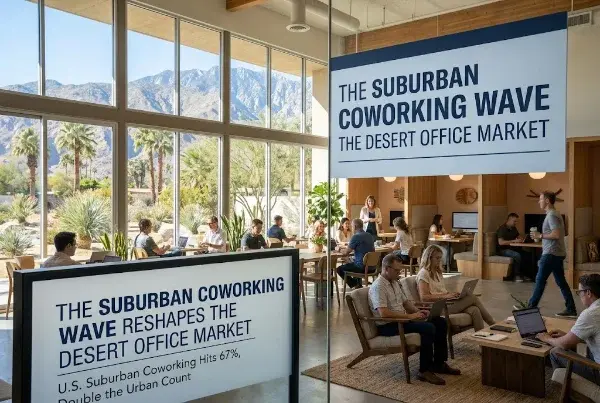
The Suburban Coworking Wave Reshapes the Desert Office Market
The American office footprint is undergoing a profound structural realignment as flexible workspaces rapidly migrate away from dense metropolitan cores. According to national research from Yardi Kube, suburban locations now command 67% of all U.S. coworking spaces, totaling 6,247 locations—nearly double the 3,137 spaces operating in urban centers. Between July 2024 and July 2026, suburban coworking surged by 39%, adding 1,763 outposts nationwide, while urban spaces recorded a modest 22% increase with 563 additions. Across the country, total coworking supply expanded from 7,058 locations encompassing 127.7 million square feet to 9,384 locations spanning more than 166.3 million square feet. This pivot highlights an evolving real estate dynamic where urban cores remain home to larger anchor facilities averaging 22,827 square feet, while suburban markets favor a high-volume, distributed network of compact footprints averaging 15,185 square feet.
This outward migration is having a tangible impact across Southern California, finding a natural testing ground in decentralized resort-suburban corridors like the Coachella Valley. Long celebrated as a seasonal haven for hospitality and tourism, the desert region has evolved into a year-round base for remote executives, tech consultants, and hybrid professionals relocating from coastal metropolitan hubs like Los Angeles, Orange County, and San Diego. Because the Coachella Valley lacks the high-density corporate skyscrapers typical of coastal downtowns, its commercial landscape mirrors the national suburban paradigm: high demand for agile, community-embedded satellite workspaces that cut down long commutes without sacrificing professional infrastructure.
In cities spanning Palm Springs, Cathedral City, and Palm Desert, flexible workplace providers are meeting this influx with tailored spaces that emphasize boutique aesthetics and turnkey private suites. Venues such as The Hive Coworking and Regus on Palm Canyon Drive illustrate how flexible offices cater to both permanent desert residents and seasonal "snowbird" knowledge workers who require quiet conference facilities, high-speed fiber connectivity, and hot desks. Rather than leasing conventional long-term commercial square footage that risks sitting underutilized during scorching summer contractions, desert-based professionals and regional service firms increasingly rely on shared memberships to manage variable operating costs.
Furthermore, California markets are illustrating how flexible workspace serves as an economic bridge. Yardi’s findings highlighted California’s Central Valley as the nation's fastest-growing overall coworking market, surging 69% in two years and demonstrating the strength of non-coastal inland hubs. In a similar vein, the Coachella Valley benefits from lower commercial overhead compared to major coastal metros, enabling operators to deliver flexible, tech-enabled offices closer to residential neighborhoods. As national workforce preferences permanently institutionalize hybrid schedules, the Coachella Valley stands out as a prime beneficiary, transforming the traditional suburban model into an active, lifestyle-driven workspace ecosystem.
Source: Yardi Kube, U.S. Suburban Coworking Hits 67%, Double the Urban Count(https://www.yardikube.com/blog/urban-vs-suburban-coworking-2026/).