Tariffs, Triggered: Supreme Court Limits Trump’s Emergency Trade Powers
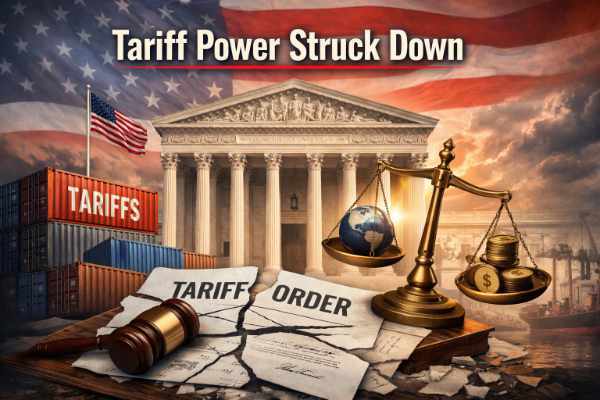
In a 6–3 decision issued February 20, 2026, the U.S. Supreme Court ruled that President Trump’s use of the International Emergency Economic Powers Act (IEEPA) to impose sweeping global tariffs exceeded statutory authority.¹ The majority held that IEEPA does not clearly authorize broad tariff imposition absent specific congressional direction.²
The Court emphasized that tariffs operate as a form of taxation and that Article I of the Constitution grants Congress primary authority over taxation and regulation of foreign commerce.³ The ruling narrows presidential reliance on emergency powers but does not eliminate tariff authority under other statutes.
Tariffs implemented under Section 232 (national security) and Section 301 (unfair trade practices) remain unaffected by this decision.⁴
The Court declined to address whether previously collected tariff revenues must be refunded.⁵ That issue is expected to be litigated through the U.S. Court of International Trade and administered via U.S. Customs and Border Protection refund mechanisms.
If refunds are ordered, they would typically be paid to importers of record — the entities that remitted duties — rather than to retail consumers.⁶ There is no automatic statutory mechanism requiring retailers to reimburse consumers for price increases attributed to tariffs.
For regional economies such as the Coachella Valley and Palm Springs, the potential impact would likely be indirect and gradual, depending on how supply chains, distributors, and competitive pressures respond.
The decision primarily recalibrates constitutional authority between Congress and the executive branch rather than producing immediate consumer price reversals.
- U.S. Supreme Court decision, February 20, 2026.
- Majority opinion, 6–3 ruling interpreting IEEPA authority.
- U.S. Constitution, Article I, Section 8.
- Trade Expansion Act of 1962 (Section 232); Trade Act of 1974 (Section 301).
- Dissenting opinion discussion regarding repayment implications.
- U.S. Customs and Border Protection refund procedures; Court of International Trade precedent.
 \
\ 



Comments